

Cats in dream meaning usually come down to one simple thing: how the cat made you feel. A purring cat on your lap and a hissing one in your doorway can come from the very same mind, yet they say very different things.
Cats carry intuition, independence, and a touch of mystery, and your sleeping brain borrows them to talk about boundaries, trust and the people you can’t quite read. Below, you’ll find common scenarios, two handy tables, cultural and psychological views, and a simple check to decode your own dream.
Quick Answer
Cats in dream meaning often point to intuition, independence, and how you handle trust. A calm or friendly cat often suggests comfort and self reliance; an attacking, hissing, or dead cat more often reflects conflict, worries about betrayal, or an ending. The cat’s behavior, color, where it appears and how you felt decide which reading fits. There is no solid evidence a cat dream predicts events.
What Does It Mean When You Dream About Cats?
Dreaming about cats often points to intuition, independence, and how you handle trust, with the exact meaning set by what the cat did and how you felt.
Three readings come up most often:
- Your gut feeling. A cat that watches quietly, or appears just as you’re dithering over a decision, often stands in for intuition, instinct, or curiosity. Your subconscious may have noticed what your thinking mind hasn’t.
- Your boundaries. A cat that drifts in and out on its own terms can mean self reliance, or a need for space you haven’t asked for yet.
- Someone hard to read. The cat may wear the face of a new partner or a friend who’s gone quiet. And no, it isn’t only about women, whatever older cat dream interpretation guides claim.
To read your own dream, use the Behavior Mood Setting check: what the cat did, how you felt, and where it happened. Mood comes first, which is why cats in dream meaning can flip completely from one dreamer to the next.
Worked example (hypothetical): a cat sits on your chest, purring, in your bedroom, and you feel safe. Behavior: purring. Mood: safe. Setting: bedroom. Together they suggest comfort and trust in private life, so ask where you’d like more of that. For other creatures, see our animal dream meanings guide.
Is Dreaming of a Cat Good or Bad?
Dreaming of a cat is neither good nor bad on its own: a calm or affectionate cat often reads as comfort and self reliance, while a hostile one points to conflict or mistrust.
- Calm or purring. A cat curled on your lap suggests you’re at ease with yourself, or craving that ease.
- Hostile or hissing. Your gut may be flagging a person or situation that doesn’t feel safe.
- Indifferent. The cat strolls off. That can sting like rejection, stir jealousy if it favors someone else, or show you’ve stopped needing approval.
This question trips up most guides to cats in dream meaning, which either pick a side or shrug. Try this tiebreaker: ask who held the power in the dream, you or the cat. If you did, the dream leans toward confidence; if the cat did, toward unease. It’s a rule of thumb, not a research finding.
What Does It Mean When a Cat Attacks, Bites or Chases You?
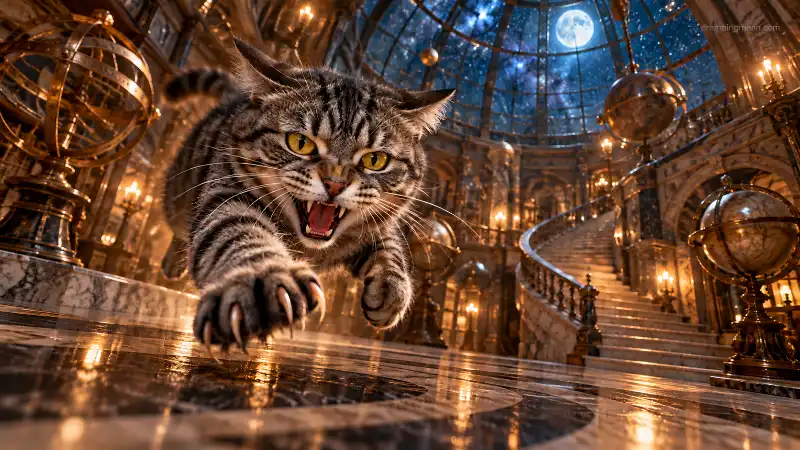
A cat that attacks, bites, or chases you in a dream usually reflects a conflict, boundary, or feeling you’re avoiding, not a prediction that someone will hurt you.
- Attack or scratch. Claws out often means a boundary has been crossed, or guilt is turning inward. Ask whether the anger felt like someone else’s or your own.
- A bite. A sudden emotional hurt: criticism or a betrayal you didn’t see coming. Ask what stung you lately.
- Chased or followed. Classic avoidance. That conversation you keep postponing has learned to run on four legs. A cat that only follows may just want attention.
- Clinging or sitting on you. Closeness or smothering. Warm usually means comfort; heavy usually means someone’s expectations.
Before you decide someone is against you, ask who the cat reminded you of, and whether you felt afraid or merely startled.
Cats in Dream Meaning by Color and Type: Black, White, Orange and Kittens

Cat color shades the mood of a cat dream: black leans toward the unknown, white toward calm or renewal, orange toward warmth and energy, and kittens toward something new and vulnerable.
Table 1: Cat color and type
| Type | Common reading | Fits when |
|---|---|---|
| Black cat | The unknown, hidden feelings | You’re facing something you can’t see clearly |
| White cat | Calm, a fresh start, remembrance | You’re healing or missing someone |
| Orange or ginger cat | Warmth, energy, playfulness | A relationship or project feels lively |
| Grey or tabby cat | Ambivalence, a middle ground | You’re undecided |
| Kitten | Something new that needs care | A fresh idea, responsibility or relationship |
| Calico or tortoiseshell | Mixed feelings, many sides | You feel pulled in two directions |
So why does cat dream symbolism contradict itself on black cats? Because the folklore can’t agree. In some British and Japanese folk traditions, a black cat is lucky; in medieval Europe, and in some modern Western superstition, it was an omen tied to witches. Let your own mood decide. A black cat that felt protective is worth treating as protective.
What Does It Mean to Dream of a Dead, Sick or Lost Cat?
A dead, sick, or missing cat in a dream often points to an ending, a worry, or a loss of comfort, and there is no evidence it signals that your own cat will die or fall ill.
- A dead cat. An ending, such as a chapter, habit, or friendship, or grief that hasn’t had room yet. Notice whether you felt relief or sorrow.
- A sick or injured cat. A neglected need, yours or someone else’s, or a quiet worry you haven’t named.
- A lost or stray cat. Feeling unanchored, or an independent part of you wandering off. A stray that approaches may be asking you to care for something you’ve overlooked.
- Your own cat, or a pet who has died. Gentler than people fear. Grief researchers describe a continuing bond with those we’ve lost, so seeing a beloved cat again can feel like comfort rather than an omen.
Some people wake with ache and warmth at once. Both can be true. When it comes to cats in dream meaning, an ending in the dream is rarely a literal one, but if your own cat seems unwell in real life, book the vet.
Where Did the Cat Appear, and What Did It Do?
Where a cat appears in a dream and what it does often shows which area of life is involved: the home and bed point to private life and trust, many cats to competing demands, and hissing or meowing to a message you’re ignoring.
- In the house or bed. Trust, intimacy, or family tension; a house cat mirrors how safe you feel.
- Many cats. Too many demands at once, or several people vying for your attention.
- Meowing, hissing or talking. Something wants your attention. A puffed tail and a hiss can mirror unease you’ve been brushing off.
- Hunting or catching prey. Instinct at work: part of you quietly going after something it wants.
- Turning into a cat. Trying on independence, or wishing to slip away unnoticed.
- A cat and a dog together. A tug between independence and loyalty, in one reading.
Table 2: Cats in dream meaning scenarios at a glance
| Scenario | Likely meaning | Emotional theme | Ask yourself |
|---|---|---|---|
| Attacked | Boundary violated | Anger, fear | Who or what is crossing a line? |
| Bitten | Sudden emotional hurt | Shock, betrayal | What stung me lately? |
| Chased | Avoiding something | Anxiety | What am I postponing? |
| Dead cat | An ending | Grief, relief | What just ended? |
| Calm cat | Self-reliance, comfort | Peace | What feels easier now? |
| In the bed | Trust and intimacy | Vulnerability | What feels unguarded? |
| Many cats | Competing demands | Overwhelm | What’s piling up? |
| Hissing | A warning I’m ignoring | Unease | What does my gut say? |
Cats in Dream Meaning and Psychology
Psychologically, cats in a dream most likely reflect how your mind is processing independence, intimacy, and unspoken emotion, not a fixed symbol with one meaning.
- Jung. Some followers of Carl Jung treat the cat as an archetype of instinct and, in a man’s dreams, of the anima, the inner feminine. A cat can also stand for the shadow self, the secretive parts we don’t show. That’s interpretation, not evidence.
- Freud. He read dream images as disguised wishes, so an unsettling cat might point to something you want but won’t admit. Many modern psychologists find that too rigid.
- Hartmann. Ernest Hartmann proposed that a dream’s central image pictures your strongest emotion. A hissing cat may be what mistrust looks like.
- Domhoff’s continuity hypothesis. G. William Domhoff and others find that dreams echo waking concerns, so people who live with cats, or dread them, may meet one at night more often. For someone with ailurophobia (fear of cats), the dream may simply be that fear.
- Barrett. Harvard Medical School psychologist Deirdre Barrett calls dreaming thinking in a different biochemical state, and cautions that a dream isn’t automatically wiser than waking thought.
REM sleep, when most vivid dreaming happens, is thought to help the brain with emotional processing, so some cat dreams are simply overnight sorting. And that’s fine.
Cats in Dream Meaning Across Cultures and Religions
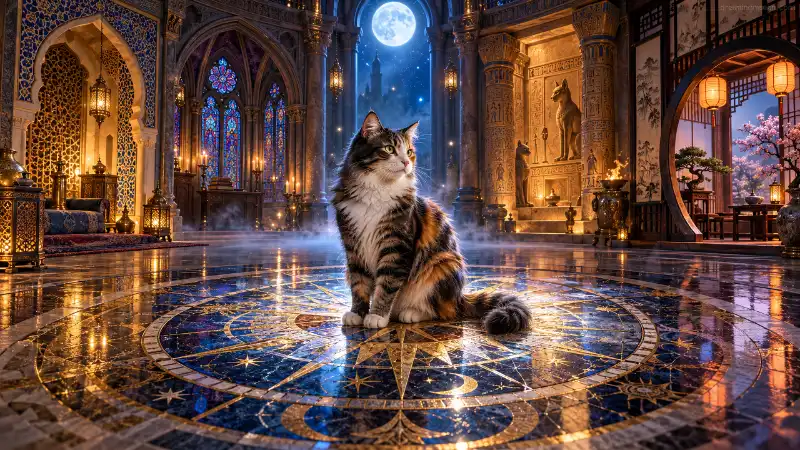
Cultures read cats very differently: ancient Egypt honored them through the goddess Bastet, Japan sees the maneki neko as lucky, and medieval Europe linked black cats to witchcraft.
So the same dream can feel protective or ominous, depending on your background.
- Ancient Egypt. Bastet, shown as a cat or cat headed woman, was associated with protecting homes and families.
- Japan. The maneki neko, or beckoning cat, is a charm for welcoming luck, familiar in Chinese communities too.
- Medieval Europe. Cats became tied to witches and their familiars, which is where much ominous folklore began.
- Islam. Islamic tradition treats cats as ritually clean and deserving of kindness, and the companion Abu Hurayra’s name is often translated as “father of the kitten.” That describes attitudes toward cats, not a fixed dream reading, so ask a qualified scholar about your own dream.
- Hinduism. The child protecting goddess Shashthi is traditionally pictured riding a cat, so a cat can read as nurturing.
- Christianity. The Bible says almost nothing about domestic cats. The one mention I know of, in the Letter of Jeremiah (Baruch 6:22, in some Bibles but not Protestant ones), has cats perching on powerless idols. Christian readings rest on folklore and personal faith.
Layer these beliefs onto cats in dream meaning and you get a map, not a rulebook. The spiritual meaning you find, whether spirit animal, guardian, or quiet omen, is yours to keep.
What Real Life Situations Trigger Cat Dreams, and When Can You Ignore Them?
Cat dreams most often follow stress, a relationship that feels hard to read, grief, or simply time spent around cats, and a one off dream with no clear trigger is usually safe to let go.
- Cats in daily life. If you own, adore, or fear cats, the dream may be plain continuity.
- Grief or change. A loss or a move can bring a cat back, often as comfort.
- Pregnancy. Dreams tend to be vivid, and a cat usually mirrors protectiveness or worry about change, not a prophecy.
- Recurring cat dreams. Keep a dream journal, note what’s happening in waking life each time, and take one small step. To ask for an answer, try dream incubation: pose one gentle question before sleep.
Nightmares several times a week, or ones that began after a frightening event, are worth discussing with a doctor or therapist. Stress and trauma can both shape dreams, and you don’t have to untangle that alone.
Frequently Asked Questions
What do cats mean in a dream in simple terms?
Cats in dream meaning most often stand for intuition, independence and trust, shaped by what the cat did and how you felt. Calm cats suggest comfort; hostile or dead ones suggest conflict or an ending.
Does a cat attack in a dream mean someone is against me?
A cat attack in a dream does not necessarily mean someone is against you. It more often reflects a boundary or feeling you’re avoiding, so look for real life evidence before acting on it.
Does a dead cat in my dream mean my cat will die?
No. A dead cat in a dream often points to an ending, a worry, or unprocessed grief, and there is no solid evidence that a dream predicts a pet’s death. If your cat seems unwell, see a vet.
Why do I keep dreaming about cats?
Recurring cat dreams often suggest a theme, such as a relationship, a boundary, grief, or simply your love of cats, is still active. Keep a dream journal and note what is happening in waking life each time.
What does a cat mean in a dream in Islam, the Bible, or Hinduism?
Cat dream readings differ by tradition, and few give a fixed meaning. Islam treats cats as clean and deserving of kindness, the Bible says almost nothing about them, and Hinduism pictures Shashthi riding a cat.
Do cat dreams predict the future?
There is no solid evidence that cat dreams predict the future. Research links dreams to emotions and waking concerns, so they are better read as reflections of what you feel now than as forecasts.
What does it mean to dream about cats during pregnancy?
Pregnancy dreams are often vivid, and a cat tends to mirror protectiveness or worry about change, not a prediction about the baby. If the dream leaves you anxious, mention it to your midwife or doctor.
What is the spiritual meaning of a cat in a dream?
Spiritually, a cat in a dream is often read as intuition, protection, or a message from the subconscious. Some traditions treat the cat as a guardian spirit, others as an omen, so your own beliefs shape the reading.
Conclusion
Cats in dream meaning are rarely about the cat alone. They’re about you: what you sense, where you need space, and who you trust. Run the Behavior Mood Setting check, write down the feeling, and give it one small step. Once you’ve done that a few times, cats in dream meaning start to feel a lot less mysterious.
Be gentle with yourself on waking. You’re allowed to take the comfort and leave the omens. Whatever the cat did, it was your own mind padding quietly into the room.

Lead Dream Analyst & Content Writer
Sarah has spent over eight years studying the psychology of sleep and dreams, blending academic research with practical, everyday interpretation. She holds a background in psychology and has a deep interest in Jungian dream theory, symbolism, and the connection between emotional wellbeing and subconscious imagery.


