

Nebuchadnezzar dream meaning begins with two unforgettable images: an enormous statue collapsing into dust and a flourishing tree cut down to its stump. Both visions appear in the Book of Daniel, and both disturb a king who seems to possess everythingwealth, authority, and an empire. Yet they tell different stories.
Daniel 2 concerns kingdoms that rise and fall; Daniel 4 confronts a ruler’s pride and describes his eventual restoration. Together, the dreams raise questions that still feel personal. What makes power secure? What happens when someone loses it? And can a painful downfall lead to genuine change?
Quick Answer
Nebuchadnezzar dream meaning depends on which biblical vision you mean. In Daniel 2, a statue made of gold, silver, bronze, iron, and clay represents successive earthly kingdoms; a stone destroys it, symbolizing God’s enduring kingdom. In Daniel 4, a great tree represents Nebuchadnezzar himself. Its cutting down foretells his humiliation, while the surviving stump points toward restoration. Both dreams contrast limited human authority with divine sovereignty.
Nebuchadnezzar Dream Meaning in Daniel 2: What Does the Statue Represent?
The statue in Nebuchadnezzar’s first dream represents successive earthly kingdoms that will ultimately give way to God’s everlasting kingdom.
According to Daniel 2, Nebuchadnezzar is so troubled by a dream that he summons Babylon’s wise men. He demands not just an interpretation but an account of the dream itself. They cannot satisfy him. Daniel, a young Jewish exile, prays and receives the mystery in a nighttime vision.
The king commands an empire, yet cannot command an answer. Daniel credits God for his insight.
What Did Nebuchadnezzar See?
The towering statue has a gold head, silver chest and arms, bronze belly and thighs, iron legs, and feet mixing iron with clay. Then a stone, cut without human hands, strikes those feet. The entire statue shatters, and the wind carries its fragments away. The stone grows into a mountain filling the earth (Daniel 2:31–35).
Something magnificent disappears; something small endures.
For readers exploring Nebuchadnezzar dream meaning, the statue isn’t a blueprint of every government; it represents power that eventually ends.
What Do the Statue’s Metals Mean?
Daniel identifies Nebuchadnezzar as the head of gold. The remaining materials signify later kingdoms, which the chapter does not name. One traditional Christian interpretation is:
| Statue symbol | Traditional interpretation | Verse |
| Gold head | Nebuchadnezzar and Babylon | Daniel 2:38 |
| Silver chest and arms | Medo Persian Empire | Daniel 2:39 |
| Bronze belly and thighs | Greek Empire | Daniel 2:39 |
| Iron legs | Roman Empire | Daniel 2:40 |
| Iron and clay feet | Divided, unstable kingdom | Daniel 2:41–43 |
| Stone becoming a mountain | God’s everlasting kingdom | Daniel 2:44–45 |
This is one traditional Christian reading, not a list of empires explicitly named in the chapter.
Why Do Iron and Clay Matter?
Iron suggests strength; clay, fragility. Daniel describes a divided kingdom that cannot hold together. The stone strikes its unstable foundation.
Those interpretations matter when explaining Nebuchadnezzar dream meaning: some futurists see a revived Roman Empire in the feet, but Daniel does not explicitly identify it.
What Does the Stone Cut Without Hands Mean?
The stone represents God’s indestructible kingdom (Daniel 2:44–45); Christians also associate it with Christ’s reign. Unlike the statue, it is not made through human effort. Here, Nebuchadnezzar dream meaning is clear: earthly power passes; God’s kingdom lasts.
Which Four Kingdoms Appear in Nebuchadnezzar’s Dream?
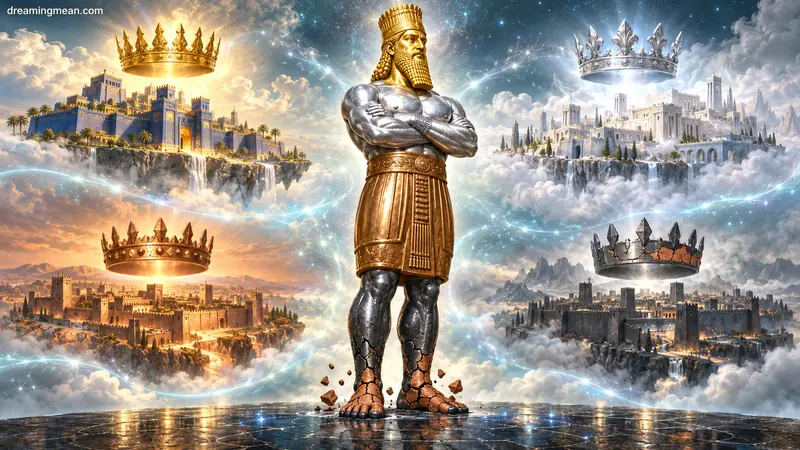
The four kingdoms symbolize successive world powers, but religious traditions and biblical scholars disagree about their historical identities.
A familiar Christian reading identifies Babylon, Medo Persia, Greece, and Rome. Here, the iron legs represent Rome; the mixed feet may symbolize its later division.
A different historical critical reading identifies Babylon, Media, Persia, and Greece. It separates Media and Persia and links the final kingdom to Hellenistic rule. The USCCB’s Daniel 2 notes explain this historical sequence.
Crucially, Daniel 2 does not name Rome as the iron kingdom. Only the golden head is explicitly identified.
Commentaries sometimes disagree because they approach prophecy, chronology, and history differently.
Some futurists read the statue as pointing toward the Antichrist or end times events; others emphasize ancient fulfillment. No modern country or leader is named.
A trustworthy explanation of Nebuchadnezzar dream meaning should show where the biblical account ends and theological debate begins.
Nebuchadnezzar Dream Meaning in Daniel 4: Why Was the Great Tree Cut Down?
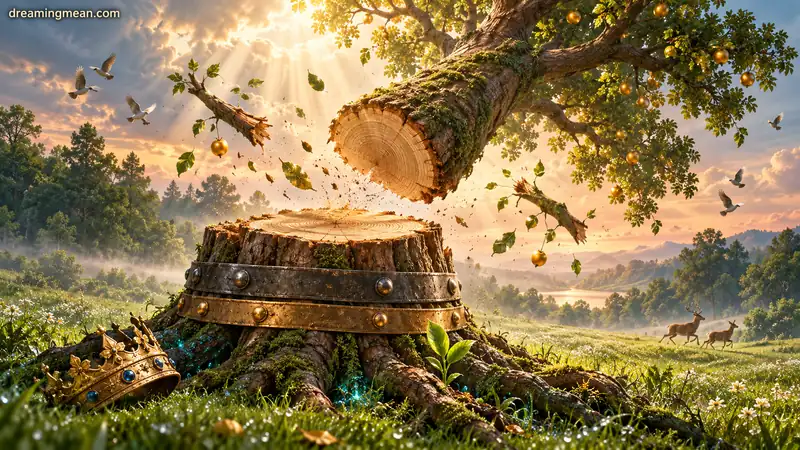
The great tree in Nebuchadnezzar’s second dream represents the king himself; its destruction predicts his humiliation, and the preserved stump signals possible restoration.
Daniel 4 describes a huge tree offering fruit and shelter. Its abundance reflects the reach of Nebuchadnezzar’s rule.
What Does the Towering Tree Represent?
Daniel identifies the king with the tree: impressive, protective, seemingly secure. Yet greatness does not guarantee safety.
Why Does a Watcher Cut It Down?
A heavenly watcher orders the tree felled. Daniel interprets this as the loss of Nebuchadnezzar’s royal position. When the king boasts of Babylon’s splendor as his own achievement, judgment follows.
Daniel had already urged the king to show mercy to the poor. The warning concerns pride and responsibility, not status alone.
The personal side of Nebuchadnezzar dream meaning comes into focus here: does success change how we treat those who depend on us?
What Do the Stump and Metal Bands Mean?
A stump remains, bound with iron and bronze. Daniel says the kingdom will be preserved until the king acknowledges heaven’s rule. The bands lack an explicitly stated individual meaning.
Unlike the vanished statue, the tree retains its roots. Restoration is central to this second Nebuchadnezzar dream meaning.
What Do the Seven Times Mean?
During the seven times, Nebuchadnezzar lives in an animal like condition. Many understand these periods as seven years, though the narrative cannot independently establish the historical duration.
After acknowledging God’s authority, Nebuchadnezzar regains his understanding and kingship. His journey runs from pride through humiliation to restoration.
What Is the Difference Between Nebuchadnezzar’s Two Dreams?
Daniel 2 addresses the fate of earthly kingdoms, while Daniel 4 addresses Nebuchadnezzar’s personal pride, downfall, and restoration.
| Feature | Statue dream | Tree dream |
| Chapter | Daniel 2 | Daniel 4 |
| Central image | Multi material statue | Great tree |
| Main concern | Succession of kingdoms | One king’s accountability |
| Turning point | Stone destroys the statue | Watcher orders tree cut down |
| Outcome | God’s kingdom endures | King is restored |
| Shared lesson | Human power has limits | Human power has limits |
The statue vanishes; the stump survives. That contrast is central to Nebuchadnezzar dream meaning: one dream ends an empire, while the other leaves room for personal change.
How Do Culture, Religion, and Psychology Interpret These Dreams?
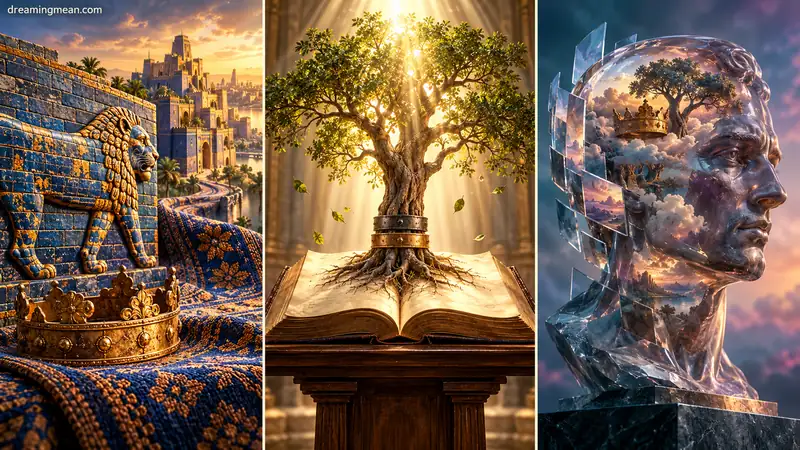
Ancient Babylonian culture explains why royal dreams mattered, biblical theology explains Daniel’s message, and psychology offers cautious ways to reflect on similar symbols today.
Ancient Babylonian Culture
Dream interpretation was part of Mesopotamian intellectual and religious life. Surviving clay tablets record dream omensattempts to connect dream experiences with possible outcomes. A Penn Museum discussion of a Babylonian dream tablet offers a concrete example.
This explains the court advisers’ role, while Daniel credits revelation from God.
Understanding Nebuchadnezzar dream meaning also requires cultural context: these tablets document ancient beliefs, not proof that their predictions came true.
Religious and Spiritual Meaning
The statue concerns divine sovereignty; the tree concerns humility, justice, and restoration. Both challenge the notion that rulers are beyond accountability.
Jungian, Freudian, and Modern Psychological Views
Freud explored dreams in relation to unconscious wishes and conflicts. Jung emphasized imagery, personal associations, and the possible relationship between dreams and neglected aspects of psychological life. A Jungian reader might explore the falling tree as an image of wounded pride; a Freudian might ask about fears surrounding control.
These are historical theories, not scientifically proven meanings of the biblical dreams. Dream imagery also relates to experience and emotion; symbols have no single universal meaning.
What If You Dream About Nebuchadnezzar’s Statue or Tree Today?
A modern dream about a falling statue, damaged tree, or destructive stone may prompt reflection on change or control, but it does not automatically repeat Daniel’s prophecy.
A Giant Statue Collapsing
A statue cracking at its feet might echo workplace instability or lost trust in someone powerful. Did you feel afraidor relieved? Your reaction matters.
A Cut Down Tree With Living Roots
A felled tree with surviving roots might evoke relationships or hope after a loss. It isn’t a guaranteed sign of recovery.
A Small Stone Bringing Down a Building
A stone toppling a building might recall a turning point. Explore that association rather than predicting catastrophe.
To explore Nebuchadnezzar dream meaning in your own reflections, write down what happened, what you felt, and what is happening in waking life. Personal context is more useful than a fixed dream symbol dictionary.
If the same troubling dream keeps returning or disrupts your sleep, consider discussing it with a qualified mental health professional rather than searching for a frightening prophecy.
Frequently Asked Questions
How Many Important Dreams Did Nebuchadnezzar Have?
The Book of Daniel records two major dreams of Nebuchadnezzar. Daniel 2 describes a statue symbolizing successive kingdoms, while Daniel 4 describes a great tree representing the king’s pride, humiliation, and eventual restoration.
Did Nebuchadnezzar Forget His First Dream?
Daniel 2 says Nebuchadnezzar demanded that his advisers reveal both the dream and its interpretation. Some older translations suggest he forgot it; many modern translations indicate that he deliberately withheld the dream’s details.
What Does the Head of Gold Represent?
The head of gold represents Nebuchadnezzar and his Babylonian kingdom. Daniel 2:38 identifies the king directly, making this the clearest historical identification within the statue vision rather than a later speculative interpretation.
What Does the Stone Represent?
The stone represents God’s everlasting kingdom, which replaces temporary earthly kingdoms in Daniel 2:44–45. Many Christian interpreters also connect the stone with Jesus Christ and his reign, although the chapter emphasizes God’s kingdom.
Does Daniel Name All Four Kingdoms?
No. Daniel 2 identifies Nebuchadnezzar as the golden head but does not explicitly name all later kingdoms. Traditional Christian and historical critical interpreters propose different historical sequences, especially concerning Media, Persia, Greece, and Rome.
Do the Seven Times Mean Seven Years?
The seven times refer to Nebuchadnezzar’s period of humiliation in Daniel 4. Many interpreters understand them as seven years, and some translations say so, but the narrative does not independently verify the historical duration.
Did Nebuchadnezzar Have a Mental Illness?
Daniel 4 describes Nebuchadnezzar living in an animal like state but does not provide a modern medical diagnosis. Assigning him a particular psychiatric condition retrospectively would be speculative and cannot be established from the biblical narrative alone.
Does the Dream Predict the Antichrist?
Some futurist Christian interpretations connect the statue’s final kingdom with the Antichrist or a revived Roman Empire. Daniel 2 does not explicitly name the Antichrist, modern Europe, or any present day government as its fulfillment.
Conclusion
Nebuchadnezzar‘s dreams portray human power as temporary and divine sovereignty as enduring, while the tree vision also leaves room for personal restoration.Daniel 2 moves from a dazzling statue to a kingdom that lasts. Daniel 4 moves from a flourishing tree through humiliation toward renewed understanding.
Both stories have something to say about ambition, but neither needs to be turned into a prediction about your next dream.Perhaps that’s why these ancient images linger. They ask us to hold achievement with humility, remember our responsibilities to others, and recognize that losing our footing need not be the end of our story.

Dream Symbolism Researcher
Daniel specializes in cross-cultural dream symbolism, drawing on mythology, folklore, and historical interpretations from cultures around the globe from ancient Egyptian dream books to modern Western psychology. His writing focuses on giving readers a broader, more nuanced view of common dream symbols by showing how different traditions have understood the same imagery differently.


