

Waking up from a phoenix dream usually leaves you shaken and hopeful, and that reaction makes sense once you consider the symbol. Phoenix dream meaning almost always centers on rebirth, transformation, and change that only shows up after something has genuinely ended not gradual growth, but a real ending followed by something stronger rising in its place.
That’s why the message can feel so intense even when the dream was brief. But the exact meaning depends on details you’re probably already forgetting: the phoenix’s color, what it was doing, and how you felt.
Quick Answer
Dreaming about a phoenix generally symbolizes rebirth, resilience, and transformation after a difficult period but the specific meaning shifts based on the phoenix’s action (rising, flying, dying, attacking), its color, and your emotional response.
Culturally, it draws on Chinese, Egyptian, Greek, and biblical traditions of renewal; psychologically, Jungian theory reads it as a sign of individuation your Self reorganizing after a symbolic “death” of an old identity.
What Does It Mean to Dream About a Phoenix?
A phoenix dream means your subconscious is processing a major transformation usually one involving loss, endurance, and the promise of starting over stronger. It’s one of the most consistently positive symbols in dream interpretation, and that tracks, since the phoenix myth doesn’t work without the fire part first.
Unlike a dream about something blooming, a phoenix dream almost always implies something had to end, or hurt, or burn away completely before anything good could follow a breakup, a career pivot, a health scare. Your mind reached for the most dramatic survival image it had on file.
A few threads run under nearly every version of this dream:
- Resilience you endured something, and you’re still standing.
- Letting go some part of your old life or identity isn’t meant to be patched up; it’s meant to be released.
- Hope after hardship even the unsettling variants carry a thread of possibility beneath the surface.
The dreams people can’t shake are rarely the simple “rising from the ashes” version they’re the messier ones: a phoenix that dies without returning, one that gets attacked, one that keeps repeating. That’s where the real meaning usually lives.
Phoenix Dream Scenarios and What Each One Means
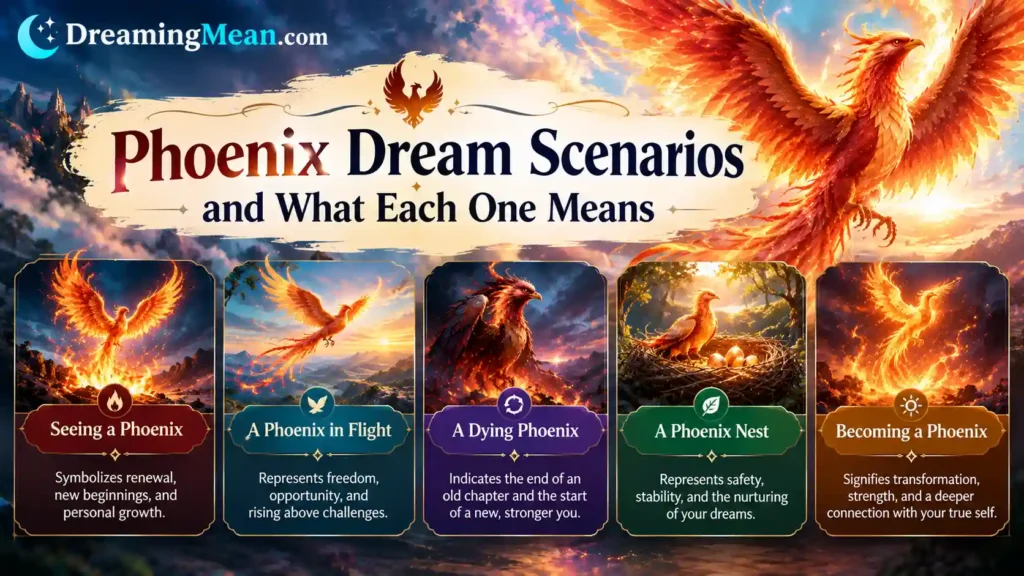
The specific action the phoenix takes changes the meaning significantly.
Scenario Core Meaning
Rising from ashes Confirmation you’ve survived and are being reborn
Flying/soaring Freedom, perspective, distance from the old situation
Bursting into flame Transformation still actively underway, right now
Resting: A pause between one cycle and the next
Circling you or your home Change approaching from outside yourself
Entering your chest/bosom New life, opportunity, or defining news
Carrying a letter/object Incoming information or a turning-point answer
Two phoenixes together Partnership reaching a more harmonious stage
Dies without returning Grief or fear the chapter is closed for good
Injured or bleeding Reputational or emotional wound still healing
Trapped or caged A needed transformation feels blocked
Flying away from you A missed opportunity or a closed chapter
Attacking or being attacked Old identity resisting the new one
You become the phoenix Personal, identity-level transformation
Phoenix tattoo A transformation you’ve already made peace with
A few worth expanding on: a phoenix that dies without returning is often skipped by dream guides trying to force a positive spin, but honestly, it can just reflect a fear that you won’t recover from a current loss a chapter that’s genuinely closed, with no reborn version in sight yet. Similarly, a phoenix attacking or being attacked usually represents a conflict between the old you and the new you, with one identity resisting the other’s takeover.
What Does the Color of the Phoenix Mean?
Color adds an emotional layer to the core rebirth symbolism, often revealing which specific feeling is driving the transformation.
Color Symbolic Meaning
Red Passion, vitality, active confidence
Blue Sadness, introspection, emotional withdrawal
Gold/Golden Success and wisdom earned through effort
Black Quiet, internal, private transformation
White A clean emotional slate; forgiveness
A red phoenix shows up when you’re actively fighting for something, not just enduring change. A blue phoenix leans toward sadness or a more withdrawn, self-protective state one account described a recurring dream of a blue phoenix overpowering a red one, lining up with a confident side of the dreamer losing ground to a more anxious one.
Does the Emotion You Felt Change the Meaning?
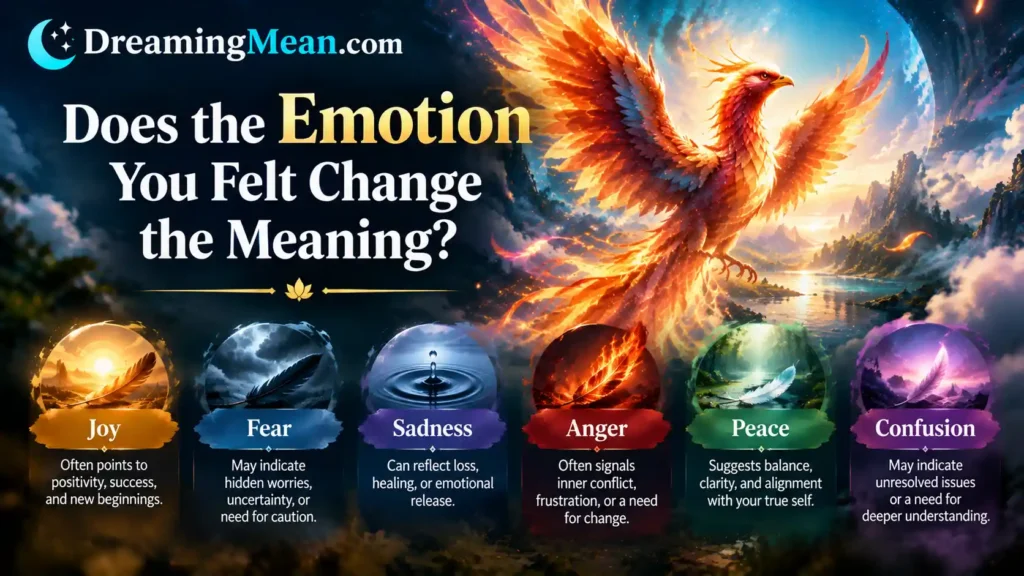
Yes the emotion you experienced while watching the phoenix often matters more than the imagery itself.
- Awe or inspiration points toward genuine readiness to embrace the coming change.
- Fear usually means resistance some part of you isn’t sold on the change being safe yet.
- Sadness or pain often signals an internal tug-of-war between two competing parts of your personality.
- Calm or peace suggests you’ve already made peace with the change, and the dream is just reflecting that back.
Write the emotional tone down fast it tends to fade faster than the visuals do.
Phoenix Dream Meaning in Different Cultures
- Chinese tradition. The phoenix (fenghuang) was historically two birds feng (male) and huang (female) merged into one symbol of nobility and harmony. It belongs to the Fire element in the Five Elements system, which is why fire adjacent imagery intensifies the meaning. Paired with a dragon, it’s considered especially lucky marital harmony or two powerful forces aligning.
- Egyptian tradition. The Bennu bird was closely tied to the sun god Ra and represented the sun’s daily rebirth the root of much of the West’s “immortality” association with the phoenix.
- Greek tradition. Herodotus wrote the most familiar account: a bird that lived roughly 500 years, then consumed itself in fire and rose again from its own ashes.
- Native American tradition. The Thunderbird is a distinct figure but shares the phoenix’s link to transformative power, which is why the two are often compared.
- Biblical tradition. The phoenix appears once in the Bible, in Job 29:18, where Job compares his hoped-for long life to the bird’s. Early Christian writers later treated it as an unofficial symbol of resurrection, though it was never formally canonized as a biblical creature.
The Psychological Meaning, According to Jung and Freud
Psychologically, a phoenix dream is one of the clearest images of what Carl Jung called individuation the ego undergoing a symbolic death so a more complete Self can emerge.
- Jungian lens: the Self archetype reorganizing itself during major life transitions, once the ego’s old defenses stop working.
- Freudian lens: the death drive (Thanatos) giving way to renewed libido destructive urges converting into something creative.
- Adlerian lens: an ongoing effort to overcome feelings of inferiority, turning a setback into fuel.
- Gestalt lens: the phoenix as a fragmented piece of your own psyche, finally being made whole.
Is It Always a Good Omen?
No. Most phoenix dreams are positive, but the dying, injured, trapped, or fleeing-phoenix scenarios lean cautionary rather than celebratory. They tend to show up when a transformation has stalled, when reputational damage is a live concern, or when grief hasn’t actually resolved. The phoenix doesn’t override any of that it just adds the transformation theme on top.
What Does It Mean If You Keep Dreaming About a Phoenix?
A recurring phoenix dream usually means your subconscious has flagged an unresolved transformation you haven’t fully completed or accepted yet. A single phoenix dream is more like a moment of realization; a repeating one is closer to a running commentary, checking back in until the change actually happens or you sit with what it’s pointing to.
Phoenix With a Dragon or Another Symbol
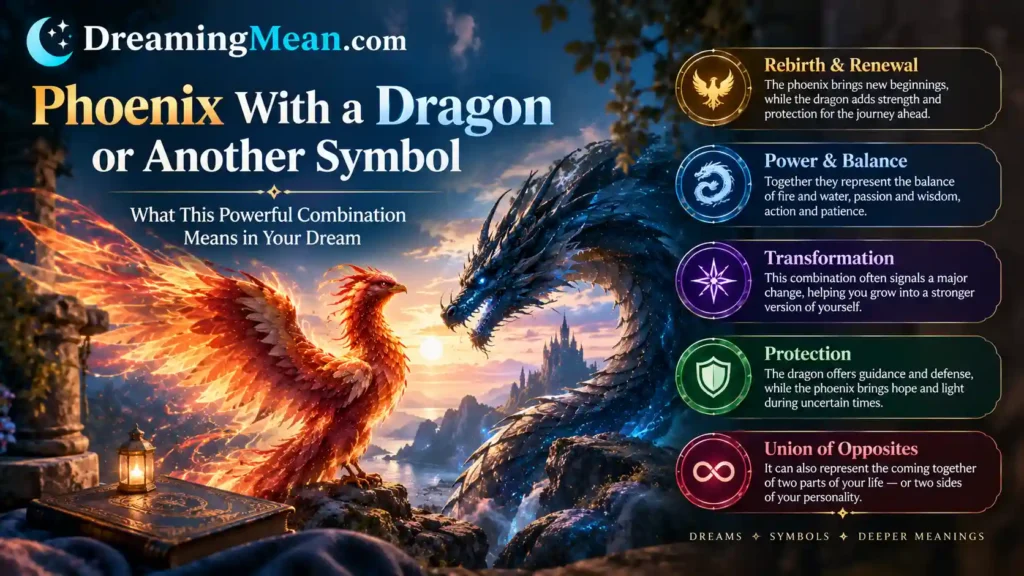
Combining a phoenix with another symbol typically layers that symbol’s meaning onto the transformation theme.
- Phoenix and dragon In Chinese symbolism, doubly lucky: success in both career and romantic partnership.
- Phoenix and fire Intensifies the message, transforming feel more urgent.
- Phoenix and water Fire and water pulling against each other signals internal imbalance; something’s running too hot and needs cooling down.
- Phoenix and a specific person The transformation is tied to that relationship, not your life in general.
Frequently Asked Questions
What does it mean to dream about a phoenix rising from ashes?
It confirms you’ve already survived a difficult period and are entering a renewed phase recovery already underway, not a warning of hardship to come.
What does a dead phoenix in a dream mean?
It often reflects fear or grief that a chapter of your life is closed for good, with no clear “rebirth” visible yet less a bad omen than an honest emotional signal.
Is dreaming of a phoenix a good sign or a warning?
Mostly positive, but injured, trapped, dying, or fleeing phoenix scenarios lean cautionary. The specific action matters more than the symbol alone.
What does it mean if you keep having the same phoenix dream?
It usually signals an unresolved transformation your mind keeps flagging until it’s addressed or completed in waking life.
What does it mean to dream you turned into a phoenix yourself?
It suggests the transformation is personal and identity-level, not just situational one of the more intense versions of this dream.
Conclusion
A phoenix dream rarely means just one thing, and treating it like a quick horoscope line kind of misses the point entirely. Understanding your phoenix dream meaning starts with the specifics: what the phoenix was doing, what color it was, and how you felt while you watched it happen. On its own, the symbol only gets you halfway there. Whatever chapter you’re in the middle of closing, the fact that your mind reached for a phoenix at all is genuinely worth sitting with. More often than not, it shows up right when you’re already further along than you feel.

Lead Dream Analyst & Content Writer
Sarah has spent over eight years studying the psychology of sleep and dreams, blending academic research with practical, everyday interpretation. She holds a background in psychology and has a deep interest in Jungian dream theory, symbolism, and the connection between emotional wellbeing and subconscious imagery.


