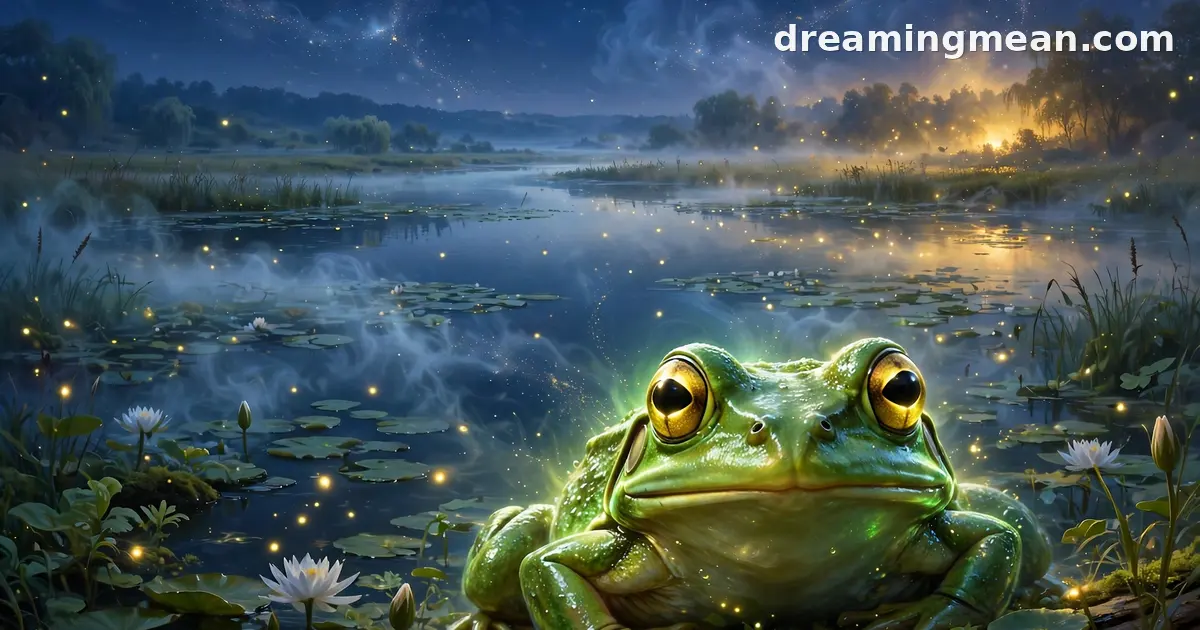
Frog dream meaning is more complicated than the ‘good luck and rebirth’ line most guides repeat. One article says a frog jumping on you means success; a dreamer who spent the night peeling frogs off their skin would disagree. Both can be right, because the same frog carries different messages depending on how you felt, what it did and where it appeared.
Below, we sort the contradictions: what frogs symbolize, why they keep returning, and what psychology, the Bible and other traditions say. Take everything as reflection, not prediction. Your dream is yours to read.
Quick Answer
Frog dream meaning usually centers on transformation: a frog signals change, renewal and, in many traditions, luck. A frog that feels friendly points to welcome change, while one that sticks to you, chases you or fills a room points to pressure, avoidance, or someone’s demands. Your feeling in the dream, what the frog did and where it appeared decide which reading fits. Dreams are reflections, not predictions.
What Does a Frog Mean in a Dream?
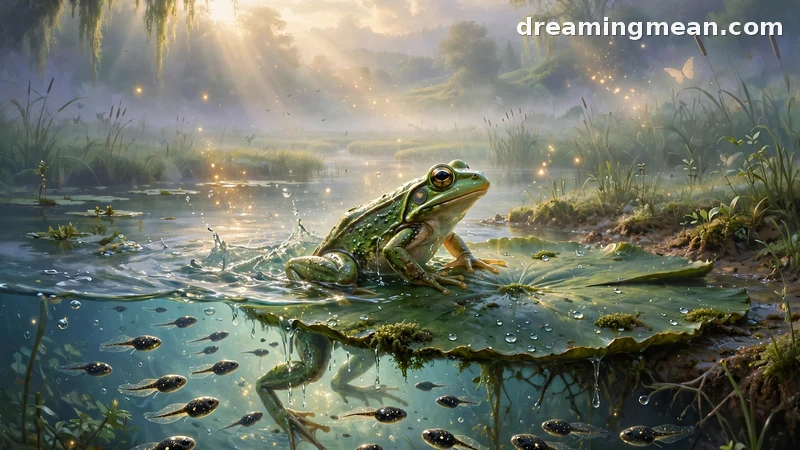
A frog in a dream most often symbolizes transformation: change already underway, usually between your emotional life (water) and your practical life (land). Many traditions add luck, fertility and prosperity, but the tone depends on how the frog felt to you.
The symbol comes from the animal. A frog begins as a tadpole, all water, and becomes a land animal still returning to the pond: metamorphosis is its life story. Its thin, permeable skin absorbs water and oxygen directly, the trait dream readers borrow for absorbing everyone else’s moods. Over 8,000 species share the shape (AmphibiaWeb), so readings vary. Three patterns cover most of the frog dream meaning:
Change already underway. The snake shedding skin dream meaning and the phoenix dream meaning picture the same move, an old self left behind; the frog adds the unfinished middle.
Luck and a leap forward. Frogs move in leaps, which luck traditions read as progress arriving all at once.
Pressure in a small shape. A crowding, clinging, multiplying frog turns the symbol: something minor alone, too much together.
That three-clue method runs through this guide to frog dream meaning.
Frog Dream Meaning by What the Frog Does
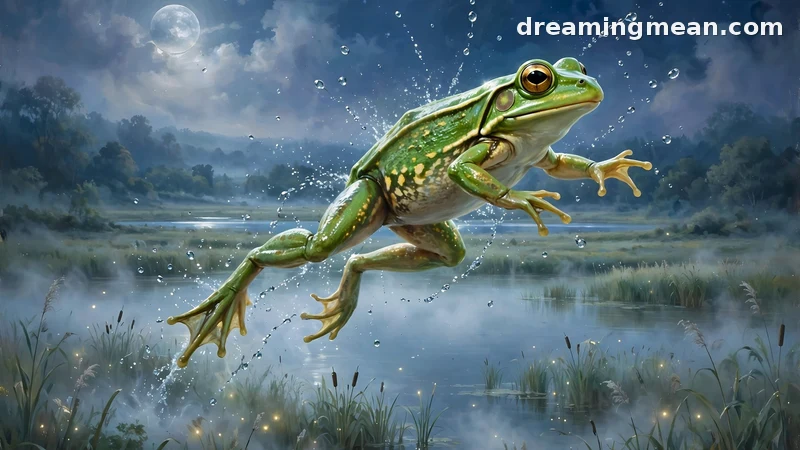
What the frog does is the strongest clue in a frog dream: a frog leaping forward signals progress, a frog sticking to you signals pressure or someone’s demands, and a frog chasing you signals something you are avoiding.
Frog Jumping on You
Guides argue most about a frog landing on you. Felt light or funny, it is a leap forward, opportunity arriving early. Felt invasive, it is an intrusion: someone in your space uninvited. The frog dream meaning here is decided by your first-second reaction.
Frogs Sticking to Your Skin
Frogs clinging to your skin picture absorption: moods and demands soaking in like water through a frog’s skin. Peeling them off is boundary work, handing back what was never yours. Readers tell us this is the frog they know best.
Frog Chasing or Biting You
A following frog wants the conversation you keep postponing. If it bites, the message has weight now: compare the rat bite dream meaning, where a bite marks an ignored problem becoming unignorable. A frog bite is rarely about pain; it is a small thing you cannot shake off.
Frog Croaking or Talking
A croaking frog is a voice: noise unheard, a complaint repeating. A talking frog is plainer: advice you already know, said out loud. In the frog dream meaning, sound is the message asking to be heard.
How Does Your Feeling Change the Meaning of a Frog Dream?
Your emotion in a frog dream decides its meaning more than the frog itself: calm or amusement suggests welcome change, while disgust, panic or feeling smothered suggests pressure, boundaries or avoidance.
Two dreamers meet the same frog and wake with opposite dreams: one reaches for it laughing, the other backs away. The frog is the picture; the feeling is the caption that carries the news. That is why the frog dream meaning starts with the feeling, not the animal.
Table 1: What Your Feeling in a Frog Dream Means
| Feeling | Likely Meaning | Ask Yourself |
|---|---|---|
| Calm, amused or curious | Welcome change, luck, curiosity | What new thing am I open to? |
| Disgust | Something unwanted you are pushing away | What am I avoiding looking at? |
| Panic or feeling smothered | Pressure, someone else’s demands | Who or what is asking too much? |
| Delight or surprise (the frog becomes something else) | Hidden potential | What looks unimpressive but may be valuable? |
Most frog dream meaning mistakes come from reading the animal alone. Mixed feelings usually mean the change itself is welcome; it is the cost that is not.
Where Did the Frog Appear, and What Happened to It?
Setting shows which life area is involved, and the frog’s fate shows how you are handling it: home points to private life, water to emotions, and a frog that dies, escapes, or turns into a prince shows how the change resolves.
In your house. Indoors, the frog dream meaning turns private: family, money, the locked-door self. One frog visits; a houseful breeds inside your walls.
In your bedroom or bed. The bedroom strips it to rest and vulnerability: what follows you there is the day’s unsettled business. In the frog dream meaning, what reaches your bed has passed every other door. Frogs felt present after waking are explained in the recurring-dreams section below.
In a pond or water. Water is the dream’s emotional register: clear water says the change feels clean; murky, that feelings are mixed. The frog is water’s small, quick signal; the alligator in dream meaning is its large, patient opposite.
The ending: dead, eaten, or transformed. A dead frog marks a finished change, like the dead cockroach dream meaning: something is over; stop feeding it. Eating one means taking the change in: the resisted idea, accepted. A frog turning prince is the oldest story: hidden value in an unpromising shape.
What Do Frog Colors and Types Mean?
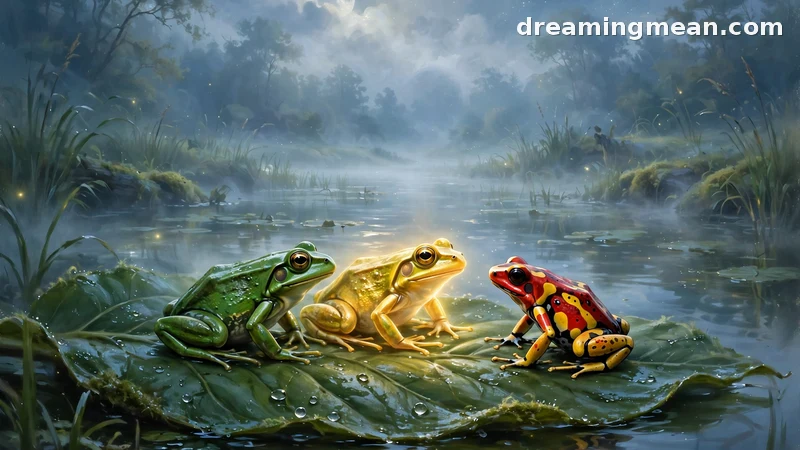
Frog color and type tune the tone: green points to growth and healing, black to hidden feelings or endings, white or golden to peace and good fortune, and red-and-yellow poison dart frogs to a toxic person or situation.
Think of color as stage lighting. It does not change the play, only how every scene feels. Black and white frogs are rare in nature, loud in dreams. In the frog dream meaning, an impossible color is a highlighter pen: read that detail first.
Table 2: Frog Colors and Types in a Dream
| Frog | Common Reading | Fits When |
|---|---|---|
| Green | Growth, healing, a fresh start | You are recovering or starting something |
| Black or dark | Hidden feelings, an ending, something unspoken | You are holding something back |
| White or golden | Peace, good fortune, clarity | The dream felt calm or luminous |
| Red-and-yellow (poison dart) | A toxic person or situation | You are handling a risky relationship |
Frog or toad? Frogs stay near water, smooth, quick: emotion, change, the leap. Toads are dry-skinned, warty, unhurried: the self’s unglamorous parts. One word serves both; the frog dream meaning covers both; the skin tells which half you met.
Why Do I Keep Dreaming of Frogs?
Recurring frog dreams usually mean a transition or emotional theme is still unresolved: a decision, a boundary, a relationship pattern or stress that your mind keeps rehearsing.
An unresolved change. A decision half-made, a move half-planned: the frog keeps returning because something’s tadpole stage is lasting too long.
Stress and overload. In crowded frog dreams, the number is the message: too many small demands, each minor, together smothering.
A waking-life cue. Rain frogs, a child’s frog toy, a nature program: the mind files the image and reuses it, Freud’s day residue.
Felt after waking. Sometimes frogs still seem present for seconds in the dark. That can be a hypnagogic effect, a cousin of sleep paralysis: common, usually harmless. If it happens often or frightens you, a doctor can check your sleep.
Keep a dream journal: date, feeling, what the frog did. It turns the frog dream meaning from a riddle into a record. When the waking change is faced, the frog dream meaning usually quiets: a returning frog is a meter, not a menace.
Frog Dream Meaning in Psychology
Psychologically, a frog dream most likely reflects how your mind is processing change, emotion and unwanted feelings, rather than predicting anything.
Hartmann: emotion makes the picture. Ernest Hartmann proposed that dreams connect emotional concerns into vivid images, the strongest feeling producing the strongest picture. A frog you cannot peel off is exactly that kind of picture: the feeling came first; the frog was hired to carry it.
Domhoff: dreams mirror the day. G. William Domhoff’s continuity hypothesis holds that dreams reflect waking thoughts and concerns. Seen this way, the frog is not a code to crack but a mirror: whatever you are mid-change about shows up wet and green by night.
Jung: the shadow and the leap. Jungian psychology reads the repulsive creature as shadow material, the unintegrated self, and transformation as individuation, becoming whole. On this reading, the frog’s disgust factor is not a flaw in the symbol. It is the symbol. None of the three treats the frog dream meaning as a prediction; all treat it as information about the dreamer.
Spiritual, Biblical and Cultural Meanings of Frogs in Dreams
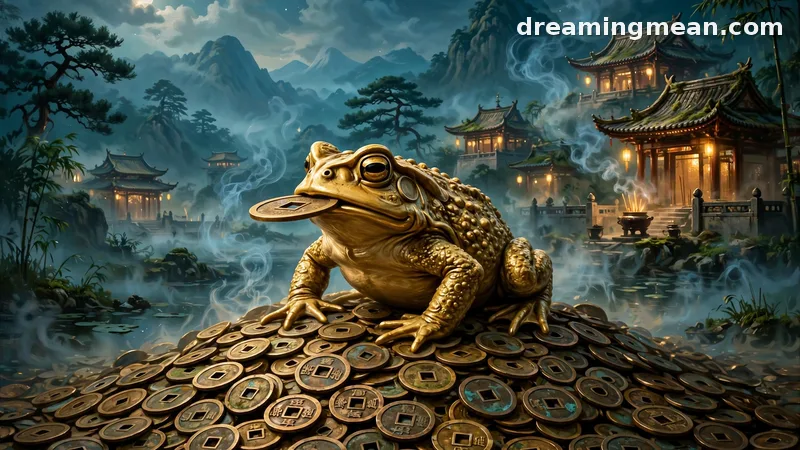
Spiritual and cultural readings of frogs span fertility and rebirth in Egypt, luck and wealth in East Asia, and plague and warning in the Bible: the tradition you read from changes the verdict.
Ancient Egypt: Heqet, the Frog Goddess
Heqet stood for fertility and childbirth. She was frog-formed or frog-headed, her amulets were worn in childbirth, and beside Khnum at his potter’s wheel she breathed life into the newborn.
The Bible: Plague and Warning
The Bible’s frogs arrive in force: Exodus 8’s second plague sends them from the Nile over Egypt, into houses and bedrooms. Revelation 16:13 turns darker: “three unclean spirits like frogs” from the dragon’s mouth. So biblical readings lean toward warning, though context and feeling can point a dream elsewhere.
East Asia: The Money Toad and the Returning Frog
East Asia keeps the frog lucky. China’s Jin Chan is, strictly, a three-legged money toad on coins, one coin in its mouth: a wealth charm. Japan’s kaeru means both “frog” and “to return,” so frog charms bring travelers home safe and sit in wallets so money returns.
Folklore: Princes and Witchcraft
Europe splits it both ways: a Frog Prince hiding worth under pond skin, toads tied to witchcraft. Hindu and Islamic traditions fix no single reading, and this guide invents none. Across all four, the frog dream meaning bends toward each culture’s own frog: midwife, plague, coin-guard, or prince.
Frequently Asked Questions
Is dreaming of a frog good or bad?
Usually good or mixed. A frog often signals change, renewal, or luck, so the frog dream meaning is rarely a warning by itself. It turns sour only when the frog felt threatening, sticky, or smothering.
What does it mean when a frog jumps on you in a dream?
A frog jumping on you means progress if it felt light or funny, pressure if it stuck to you or felt invasive. The first second’s feeling separates a leap forward from someone’s demands.
Why do I keep dreaming about frogs?
Recurring frog dreams point to a transition or emotional theme that is still unresolved: the same change, returning because its decision is still waiting. Ask a doctor about frequent, distressing sleep episodes.
What does a frog mean in the Bible?
Frogs appear in the Bible as Egypt’s second plague in Exodus 8 and as unclean spirits in Revelation, so biblical readings usually treat them as a warning. Feeling and context can still point to cleansing or deliverance.
What is the difference between frog and toad dreams?
Frogs lean to water, emotion, and transformation; toads lean to the hidden, unglamorous parts of yourself. Both share the same frog dream meaning at the core: something in your life is changing shape.
Does dreaming of a frog mean money or pregnancy?
Frogs symbolize fertility and prosperity in many traditions, from Egypt’s Heqet to China’s money toad, so some dreamers read one as money or pregnancy coming. Treat it as hopeful symbolism, never as a prediction.
Conclusion
Read your frog by its three clues: how you felt, what it did, and where it appeared. Read that way, the frog dream meaning is rarely a warning and never a fortune. It is a progress report on a change already moving. If your frog was strange or frightening, tell it in the comments; details are where the meaning hides. For more night visitors, browse our animal dreams.
References
- The Bible. Exodus, chapter 8; Revelation 16:13. King James Version.
- Hartmann, E. (2011). The Nature and Functions of Dreaming. Oxford University Press.
- Domhoff, G. W. (2003). The Scientific Study of Dreams. American Psychological Association.
- Jung, C. G. (1964). Man and His Symbols. Doubleday.
- AmphibiaWeb. University of California, Berkeley. Species counts, accessed November 2026.
- Heqet, the frog goddess of ancient Egypt, associated with fertility and childbirth.

Lead Dream Analyst & Content Writer
Sarah has spent over eight years studying the psychology of sleep and dreams, blending academic research with practical, everyday interpretation. She holds a background in psychology and has a deep interest in Jungian dream theory, symbolism, and the connection between emotional wellbeing and subconscious imagery.