

Nearly everyone who has burned through a high fever remembers at least one dream from it, the kind that felt too strange, too vivid, too real to shake off the next morning. That is the essence of fever dream meaning: it sits somewhere between biology and psychology, between “just your brain overheating” and “your mind trying to tell you something.”
If you have woken up shaken by one of these dreams, you are not imagining it, and you are truly not alone. This article covers the science and the symbolism, so you understand what happened in your head last night.
Quick Answer
A fever dream is an unusually vivid, often disturbing dream that occurs when illness raises body temperature and disrupts REM sleep. There’s no proven symbolic meaning behind fever dreams they’re primarily biological. That said, the imagery (drowning, distortion, being chased) often mirrors real emotional stress, which is why fever dream meaning can still be worth paying attention to, even without a fixed interpretation attached.
What Is a Fever Dream?
A fever dream is a vivid, often bizarre or unsettling dream that occurs when a person’s body temperature is elevated due to illness most commonly during the flu, a bad cold, or a childhood fever that spikes overnight.
It’s not just that the plot gets weird plenty of ordinary dreams are. What sets a fever dream apart is intensity: colors feel louder, fear cuts sharper, and it lingers longer. There’s also real overlap with delirium and hallucination, which is probably why these dreams feel less like “just a dream” and more like something you actually lived through.
This isn’t new, either. In the 2nd century, the Greek orator Aelius Aristides described feverish visions he believed were messages from Asclepius, the god of medicine. People have been trying to crack fever dream meaning for close to two thousand years.
A few scenarios show up again and again:
- Melting or shifting objects walls that bow inward, clocks that droop, furniture that refuses to hold its shape
- Being watched by strange, silent figures who never quite move or speak
- Repetitive, unsolvable tasks folding the same load of laundry over and over, climbing stairs that never end
Why Do Fever Dreams Happen? (The Science)
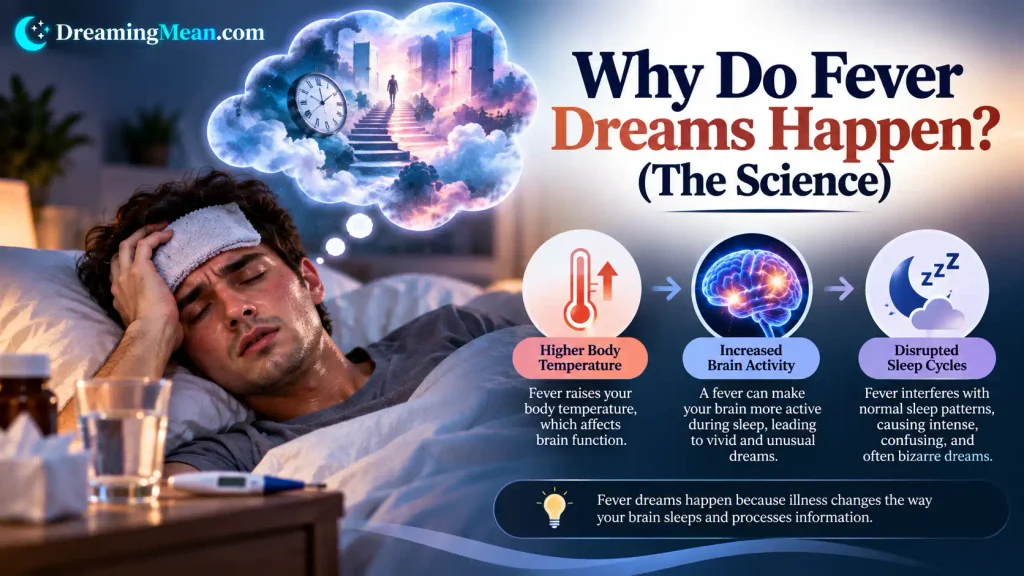
Fever dreams happen because elevated body temperature disrupts the hypothalamus and interferes with REM sleep, causing the brain to generate more bizarre and emotionally intense dream content than it normally would.
Think of your hypothalamus as your body’s thermostat. When it’s forced into overdrive fighting an infection, it changes how your brain handles information while you sleep REM sleep gets suppressed and fragmented, which makes you more likely to surface mid dream and remember it.
German dream researcher Michael Schredl has run some of the only formal studies on this. In one survey, roughly 94% of people who reported a fever dream described it as negative accounts of oversized creatures, giant insects, and spreading blackness were common.
Why Do Fever Dreams Feel So Real?
Fever dreams feel unusually real because heightened brain activity during illness weakens the normal cognitive filtering that keeps dream logic separate from waking logic, making the imagery feel more immersive and harder to dismiss on waking.
This ties to what researchers call the continuity hypothesis of dreaming the idea that dreams borrow from recent waking life experience. Your body already knows it’s overheated and uncomfortable, and that awareness bleeds straight into the dream, which may explain why so many fever dreams involve burning, drowning, or environments that just feel wrong.
Fever Dream Meaning, Is There Something Deeper Going On?

Fever dream meaning isn’t fixed or universal, but the emotional tone and imagery of a fever dream often reflect real stress, fear, or unresolved feelings that your mind processes more intensely while your body is preoccupied with fighting illness.
It’s true fever dreams are mostly biological nobody’s sending a coded message through your bloodstream. But dreams, feverish or not, pull from whatever’s already in your subconscious, and illness just turns up the volume.
That’s not far off from how Freud and Jung approached ordinary dreams, applied to a body under stress. Freud likely would’ve pointed to repressed anxiety finding an outlet; Jung might’ve called it the unconscious surfacing symbols the waking mind had been avoiding. Neither hands you a literal decoder ring, but both suggest how a fever dream feels matters more than what it shows you.
Table 1: Fever Dream Scenario → Possible Interpretation
| Dream Scenario | Possible Psychological Interpretation |
|---|---|
| Melting objects / shifting walls | A sense that your stability or control is compromised right now |
| Being chased or unable to move | Underlying anxiety or a feeling of helplessness in waking life |
| Drowning or suffocating | Overwhelm — a feeling that stress or responsibilities are “too much” |
| Giant insects or oversized creatures | A fear that something in your life is growing out of proportion |
| Reliving a childhood memory or old dream | Old, unresolved emotions resurfacing under physical stress |
| Repetitive, unsolvable tasks | Frustration, or the sense of being stuck in a real situation |
Fever Dream vs. Nightmare vs. Lucid Dream
Fever dreams differ from nightmares mainly in cause illness versus psychological triggers and from lucid dreams in awareness, since fever dreams are rarely controllable.
What’s the Difference Between a Fever Dream and a Nightmare?
A fever dream is triggered by physical illness and elevated body temperature, while a nightmare is typically triggered by stress, trauma, or anxiety without any temperature change involved.
Both feel awful and wreck your sleep, but a nightmare can happen any random night a fever dream only shows up when your body is fighting something off.
Can You Have a Lucid Fever Dream?
Yes some studies found that up to 40% of reported fever dreams had lucid qualities, compared to roughly 7.5% of dreams in healthy, non feverish sleepers.
That gap suggests the brain, even impaired by fever, sometimes retains enough self awareness to half recognize it’s dreaming even without being able to steer it.
Table 2: Fever Dream vs. Nightmare vs. Lucid Dream
| Feature | Fever Dream | Nightmare | Lucid Dream |
|---|---|---|---|
| Trigger | Illness / elevated body temperature | Stress, trauma, anxiety | Intentional practice or spontaneous |
| Awareness during dream | Usually low | Low | High — dreamer knows they’re dreaming |
| Emotional tone | Mostly negative | Negative | Variable |
| Recall clarity | Very high | High | Very high |
| Control over the dream | Rare | Rare | Common |
Fever Dreams in Children vs. Adults
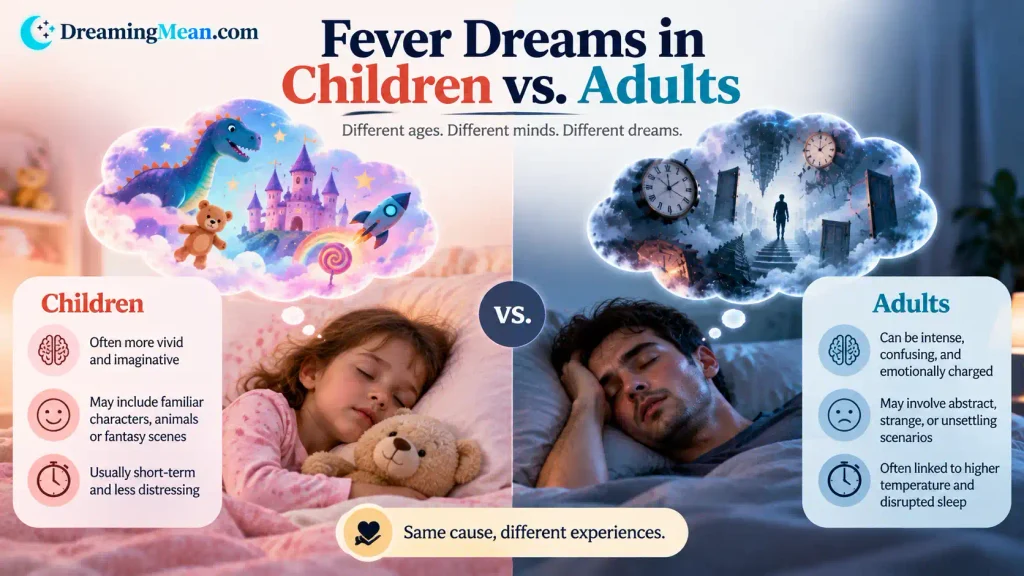
Fever dreams tend to be more common and intense in children because their fevers spike faster and their still developing sleep cycles react more strongly to temperature disruption than an adult’s.
Kids run hotter and faster, and their nervous systems haven’t built up the regulatory buffer adults eventually develop.
Adults aren’t off the hook either. A feverish adult brain often dredges up imagery or entire dreams untouched since childhood, almost like the fever reopens an old file. That “haven’t thought about this in years” dream during a bad flu shows up often enough in dream recall research to count as a real pattern.
Cultural, Historical, and Spiritual Perspectives on Fever Dreams
Beyond biology, fever dream meaning have long carried cultural weight from ancient accounts of divine visions during illness to modern spiritual readings of fever as an emotional reset.
That 2nd century account from Aristides wasn’t an isolated oddity. Fever induced visions turn up across folklore and religious tradition as moments when the “veil” between ordinary consciousness and something larger the divine, the unconscious, the soul is thought to thin. In 1892, Scottish pathologist Joseph Coats documented fever induced delirium too, noting how convincing the hallucinations felt, and how belief in them sometimes lingered after waking.
Modern spiritual takes often frame fever dream meaning around purification illness burning through something, physically and emotionally, with the dream as a byproduct of that release. This isn’t scientifically established, but it’s a genuinely old way people have made sense of an experience that otherwise feels senseless.
The phrase itself has escaped medicine entirely by now “fever dream” shows up constantly in film and book criticism to describe anything disorienting or surreal.
What Your Fever Dream Might Be Telling You
While fever dreams don’t follow a fixed dream dictionary code, certain scenarios show up often enough in research and personal reports to suggest common emotional undercurrents worth noticing.
What Does It Mean When You Dream About Melting or Distorted Objects?
Dreaming about melting or shifting objects during a fever often reflects a felt loss of stability, since your brain registers real physical instability and translates it into visual distortion. It’s usually more physiological than symbolic.
What Does It Mean When You Dream About Being Chased While Sick?
Being chased in a fever dream typically points to unresolved anxiety, since chase dreams are one of the most common anxiety linked dream patterns regardless of illness fever just cranks up the emotional volume.
What Does It Mean When You Dream the Same Fever Dream Repeatedly?
A recurring fever dream usually signals a memory or emotional pattern your mind keeps returning to under physical stress, often something first experienced in childhood. Repetition alone isn’t a warning sign it’s more a clue about an unresolved thread.
What Does It Mean When a Fever Dream Feels Like a Hallucination?
When a fever dream blurs into hallucination, it usually means the fever has significantly disrupted normal brain function, temporarily narrowing the line between dreaming and waking perception. It’s generally harmless and resolves as the fever breaks though a very high or prolonged fever paired with this symptom is worth a call to your doctor.
How to Reduce or Stop Fever Dreams
You can’t eliminate fever dreams, but lowering your fever, staying hydrated, and improving your sleep environment can reduce how often they happen and how intense they feel.
A few things that help:
- Manage the fever itself fever reducers (as advised by a doctor) shorten the window your brain spends in this disrupted state.
- Stay hydrated dehydration on top of fever makes sleep more fragmented.
- Cool your sleeping environment a cooler room reduces the temperature swings that intensify dream distortion.
- Keep some kind of sleep routine protecting whatever continuity you can helps.
When to see a doctor: if the fever climbs high (above 103°F/39.4°C in adults, or any fever in infants), or if the dream like state bleeds into waking hours as confusion, that’s no longer just a fever dream that’s a reason to call someone.
Frequently Asked Questions
What is a fever dream, in simple terms?
A fever dream meaning is an unusually vivid, unsettling dream that happens when illness raises your body temperature and disrupts sleep, making dream content feel more intense than usual.
Do fever dreams mean anything, or are they random?
Fever dreams are mostly biological, but their emotional tone often mirrors real stress, so fever dream meaning sits somewhere between random and symbolic.
Why are fever dreams almost always scary or negative?
Fever disrupts REM sleep and increases brain activity in ways that skew dream emotion negative, which is why most reported fever dreams are unpleasant.
Can adults have fever dreams the same way children do?
Yes, though children experience them more intensely because their fevers spike faster and their sleep cycles are still developing.
What’s the difference between a fever dream and a hallucination?
A fever dream happens during sleep, while a hallucination happens while awake; the two can overlap in very high fevers.
How long do fever dreams usually last?
Fever dreams typically stop once the fever breaks, usually within a day or two of the illness resolving.
Should I be worried if I keep having the same fever dream?
A recurring fever dream is usually just your mind returning to an unresolved emotional thread, though persistent distress is worth mentioning to a doctor.
Can medication cause dreams similar to fever dreams?
Yes, certain medications especially those affecting the central nervous system can independently cause vivid, strange dreams that closely resemble fever dreams.
Fever Dream Meaning: The Bottom Line
Fever dream meaning ultimately lives in the space between biology and psychology. There’s no mystical fixed code hiding in the melting walls or the strange, silent figures I wish I could tell you there was; it’d make for a better ending. But there’s nothing wrong with sitting with what those dreams felt like and why. Your body was working overtime, your brain was running hot, and somewhere in that disrupted sleep, whatever you’d been quietly carrying found its way to the surface. Not because the dream was a message. Just because, even at your worst, some part of you was still listening.

Lead Dream Analyst & Content Writer
Sarah has spent over eight years studying the psychology of sleep and dreams, blending academic research with practical, everyday interpretation. She holds a background in psychology and has a deep interest in Jungian dream theory, symbolism, and the connection between emotional wellbeing and subconscious imagery.


