

You’re walking through streets that look almost right, but not quite. Every turn leads somewhere unfamiliar. Your phone won’t load a map, and nobody you ask can help. Then you wake up, heart racing.
If you’ve searched for the meaning of a lost dream after a night like that, you’re in good company it’s one of the most common dream themes people report. Here’s the reassuring part: a lost dream rarely means what it feels like. It isn’t a warning sign. It’s your mind working something out, in its own strange way.
Quick Answer
Understanding your lost dream meaning starts with recognizing that it’s rarely about actual geography. A lost dream typically means you’re feeling uncertain, disconnected, or without direction in some part of your waking life often during a career change, relationship shift, or identity transition. The specific meaning depends on where you’re lost, who’s with you, and whether you eventually find your way. It’s a processing dream, not a predictive one.
What Does It Mean When You Dream About Being Lost?
Dreaming about being lost reflects your mind processing uncertainty about direction, purpose, or identity it’s a psychological rehearsal of disorientation, not a literal warning about your future.
Sleep researchers who study anxiety dreams point to threat simulation: the idea that your brain uses sleep to run low stakes rehearsals of threatening situations. Being lost is one of the cleanest metaphors for that, which is really the heart of any lost dream meaning. No physical danger, but real emotional stakes and part of why it tends to surface during REM sleep, the stage where the brain does much of its memory consolidation work.
That’s also why the dominant emotion is confusion rather than fear. Compare it to a chased dream nightmare, where dread sits front and center. A lost dream is quieter and stranger more like an itch you can’t locate than a threat bearing down on you. It’s about not knowing your next move, not danger.
Two schools of thought back this up, and they land in roughly the same place. Freud viewed dreams like this as a defense mechanism expressing repressed anxiety without confronting it head on. Jung framed it as individuation: your unconscious nudging you to integrate a part of yourself you’ve been avoiding. Neither treats the dream as a verdict. Both treat it as work in progress.
Common Lost Dream Scenarios and What They Mean
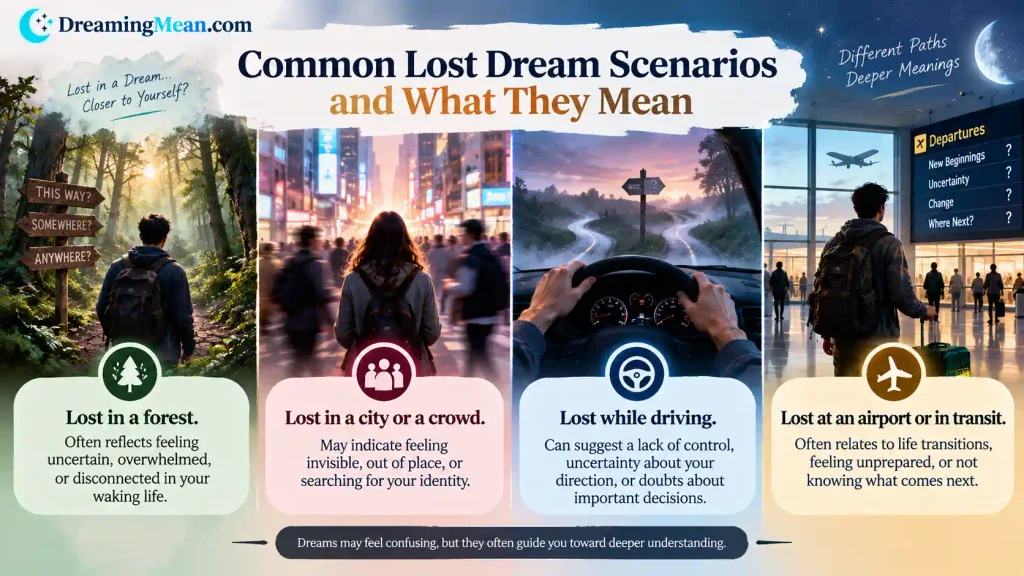
Where you get lost in the dream changes what the disorientation is pointing to, since each setting carries its own symbolic weight.
Most dream dictionaries lump every “lost” scenario into one vague bucket. But the setting does a lot of the actual interpretive work.
Lost in a forest. Dark trees, no clear path. This often points to a disconnection from your own instincts if you’ve been overriding your gut for “the sensible choice,” a forest is where that tension surfaces.
Lost in a city or a crowd. Cities usually represent complexity too many options, too much noise. Being lost among strangers who won’t help can reflect a fear of losing yourself trying to fit in.
Lost while driving. Oddly specific and surprisingly common. The roads keep shifting, or you can’t remember where you were headed reflecting a lack of control over your own direction, decisions happening around you rather than by you.
Lost at an airport or in transit. Gates you can’t find, a flight you’re not sure you’re meant to catch. This shows up during real life transitions, reflecting anxiety about a decision you haven’t fully committed to yet.
Table 1: Scenario → Likely Meaning → Reflection Question
| Scenario | Likely Meaning | Reflection Question |
|---|---|---|
| Lost in a forest | Disconnected from instinct or intuition | Where have I stopped trusting my gut? |
| Lost in a city or crowd | Overwhelmed by complexity or social pressure | What’s making life feel too noisy right now? |
| Lost while driving | Feeling out of control of your own direction | Where do I feel like a passenger in my own life? |
| Lost at an airport or in transit | Anxiety about an upcoming transition | What decision am I avoiding making? |
| Lost in the dark | Lacking the information to move forward safely | What do I need more clarity on before acting? |
What Does It Mean to Be Lost in a Familiar Place?
Being lost somewhere you should know by heart your childhood home, your hometown, your old job usually signals an identity shift rather than a memory problem.
This version feels more unsettling than getting lost somewhere new a route you drove to work for a decade is supposed to be automatic. When it isn’t, your subconscious is telling you something’s changed not the place, you.
It shows up often during ordinary life changes. Someone who’s just left a long term job, for instance, might report this exact dream in the weeks after leaving. It’s less about direction here and more about self: you’re outgrowing a role that used to fit, and the unfamiliarity of the familiar is the dream flagging that shift before you’ve consciously caught up to it.
Losing Something or Someone vs. Losing Your Way Are They the Same?
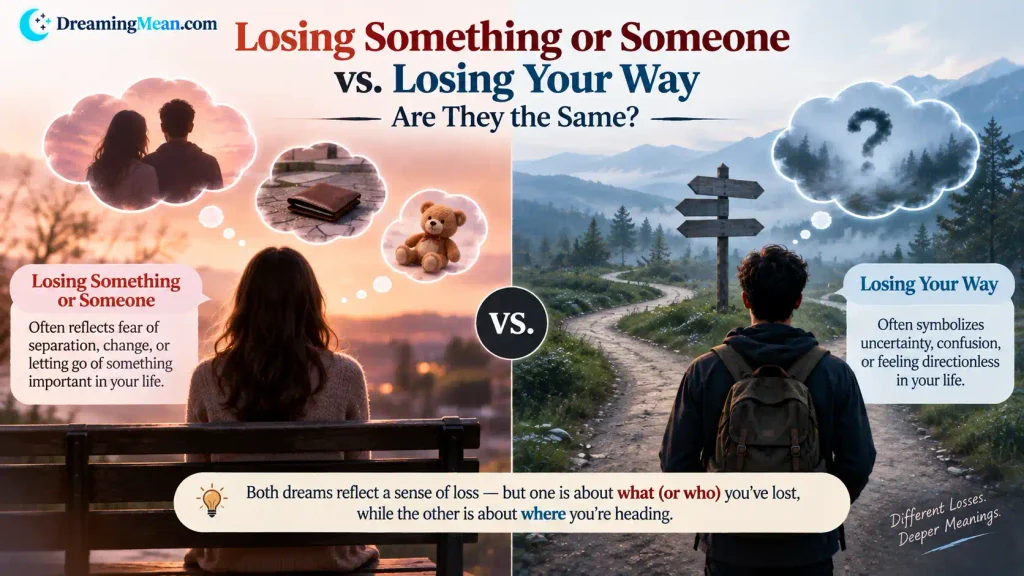
No losing an object, losing a person, and losing your own direction are three distinct dream categories, each pointing to something different.
Losing an item attaches its meaning to what the item stands for. Keys reflect anxiety about access or control. Shoes point to feeling unprepared or exposed. A missing bag reflects fear of leaving something essential behind, common in travel or transitions. Glasses symbolize difficulty seeing your next step clearly.
Losing a person depends on whether they’re living or gone. If they’ve passed, it’s often grief processing. If alive, the dream may be less about them and more about a quality you associate with them warmth, ambition, humor that feels missing in yourself.
Losing your way or sense of self is the core lost dream meaning this article is built around: direction, purpose, identity, and the discomfort of not having a clear next step.
Table 2: Type of Loss → What It Points To
| What’s Lost | What It Often Represents |
|---|---|
| Keys | Access, control, or personal agency |
| Shoes | Feeling unprepared or exposed |
| A bag or suitcase | Fear of leaving something essential behind |
| Glasses | Difficulty seeing your next step clearly |
| A person (living) | A quality you feel you’ve lost in yourself |
| A person (deceased) | Active grief processing |
| Your own direction | Purpose or identity uncertainty |
How the Dream Ends Changes the Lost Dream Meaning
Whether you find your way, give up searching, or realize you never needed a destination at all changes what the dream is ultimately telling you.
You find your way and wake up. Frustrating, since you don’t get the relief, but a decent sign your mind is close to resolving whatever’s underneath the uncertainty.
You give up looking. The searching stops. You sit down, accept the lostness, and something softens. This mirrors surrender not giving up on life, just releasing the grip on needing an answer right now.
You realize you don’t need to get anywhere. Rare, and arguably the most meaningful ending. The pressure to have a destination dissolves, suggesting a release from the belief that you always need a plan before you’re allowed to move.
Who’s with you matters too less as a checklist, more as a mirror. A stranger tagging along often represents an unfamiliar part of yourself still taking shape. Someone you know, panicking beside you, may reflect their own uncertainty bleeding into your dream. If they stay calm, that calm might be the part of you that already trusts you’ll land on your feet.
Cultural, Religious, and Psychological Perspectives on Lost Dreams

Psychology frames lost dreams as anxiety processing, while several spiritual traditions frame the same dream as a call toward guidance and the two readings aren’t in conflict.
Psychological view. Freud read this as a defense mechanism managing repressed anxiety; Jung saw it as individuation, the unconscious integrating a disowned part of the self. Many contemporary researchers lean closer to the Jungian framing: processing, not warning.
Islamic dream tradition. In some strands of Islamic interpretation, being lost is read as a prompt to re examine one’s path and seek guidance, rather than a bad omen.
Biblical and Christian framing. The lost and found parables the lost sheep, the prodigal son use “lost” as a spiritual state, with “being found” representing return and restoration.
Indigenous dream traditions. Some Indigenous traditions frame lostness less as a problem and more as part of an initiatory journey closer to a vision quest than a wrong turn.
These are traditions of interpretation, not universal facts. What they share is a refusal to treat “lost” as simply bad news across cultures, it keeps getting framed as a stage, not a verdict.
Why Do You Keep Having the Same Lost Dream?
Recurring lost dreams usually mean the underlying uncertainty hasn’t been consciously named yet, and the dream tends to repeat until it is.
Certain life stages trigger this more than others: a career change, a breakup, a move, retirement, becoming an empty nester. The “map” you’d built your identity around has shifted, and your dreaming mind keeps circling back until you catch up with it consciously.
A recurring lost dream isn’t automatically a symptom of anything clinical it’s an ordinary response to change. If it causes real distress, talking to a therapist is a reasonable next step, not an overreaction.
What Should You Do With a Lost Dream? (Practical Reflection Steps)
The goal isn’t to “solve” the dream it’s to name the uncertainty in your waking life so the dream has less to keep processing.
- Identify the setting. Use the scenario table above as a starting translation.
- Name what you were searching for. A place, a person, an object that detail usually points to what you’re seeking in real life: security, connection, or a more honest version of yourself.
- Ask which life domain feels unresolved. Career, relationship, identity, or purpose most lost dreams trace back to one of these.
- Keep a simple dream log. Note the setting, the emotion, and what was going on in your life at the time. Patterns tend to surface faster than you’d expect.
Frequently Asked Questions About Lost Dream Meaning
Is dreaming about being lost a bad sign?
No. Lost dreams are processing dreams, not predictions. They reflect present uncertainty, not future misfortune.
What does it mean to dream you’re lost and can’t find your way home?
It usually points to a search for stability or belonging feeling disconnected from whatever normally makes you feel grounded.
Why do I dream about being lost in a place I know well?
It signals an identity shift. You’re becoming someone for whom the old, familiar version of that place no longer quite fits.
Does a lost dream mean I have anxiety?
Not necessarily a diagnosis it reflects normal processing of uncertainty. If distress continues into waking hours, a mental health professional can help.
What does it mean when someone else is lost with you in the dream?
Their reaction often mirrors a part of yourself calm or panicked or someone in your life navigating something similarly disorienting.
Do children’s lost dreams mean something different than adults’?
Often, yes. Children commonly dream of being lost at school, reflecting social anxiety; adults’ versions tend to center on career or life stage uncertainty.
What’s the difference between a lost dream and a chased dream?
Chased dreams involve something behind you that you’re avoiding. Lost dreams involve the absence of something in front of you a clear direction.
How do I stop having lost dreams?
Naming the specific uncertainty they’re pointing to career, relationship, or identity tends to reduce their frequency.
Final Thoughts
At its core, lost dream meaning has little to do with actual geography and everything to do with direction in your waking life. The message shifts with the setting, the company you keep, and how or whether you find your way out. None of that makes the dream something to dread. If anything, it’s a quiet sign that some part of you is already working things out, before you’re consciously ready to admit it. Next time you wake up disoriented, try sitting with it for a minute instead of shaking it off. It might be pointing you somewhere worth going.

Dream Symbolism Researcher
Daniel specializes in cross-cultural dream symbolism, drawing on mythology, folklore, and historical interpretations from cultures around the globe — from ancient Egyptian dream books to modern Western psychology. His writing focuses on giving readers a broader, more nuanced view of common dream symbols by showing how different traditions have understood the same imagery differently.